

Lakeside with the Progressive Beekeepers of the Northeast
A Dispatch from Vermont

“He’s fourth generation,” Max explains, referring to his friend, the beekeeper Curtis Mraz. “His family has been in Vermont for like a hundred years selling honey. His uncle Chas Mraz is a hoot.”
We’re driving toward the Champlain Valley in upper Vermont, descending from the mountains of Stowe in a beat up Mercedes. The sun is low, the air crisp, and I’m DJing a set of progressive house music through the car’s tinny speakers. For the last two days we’ve been scheming about beekeeping technology; talking strategy for Nectar, the startup for which Max leads the operations and I do the marketing. Satisfied with our plan, we’ve decided without talking about it to stop talking. I put on a song by Half Moon Run, a Montreal band that we both loved in 2012.
Before we left the house, Max showed me an article about Curtis in the local paper, Seven Days: Vermont’s Independent Voice, circulation 36,000. It’s a four page spread about the family business—about the struggle to remain profitable when honey prices keep declining (because of cheap, diluted dreck imported from China) and bee mortality keeps rising (because of widespread pesticide use on commercial farms).
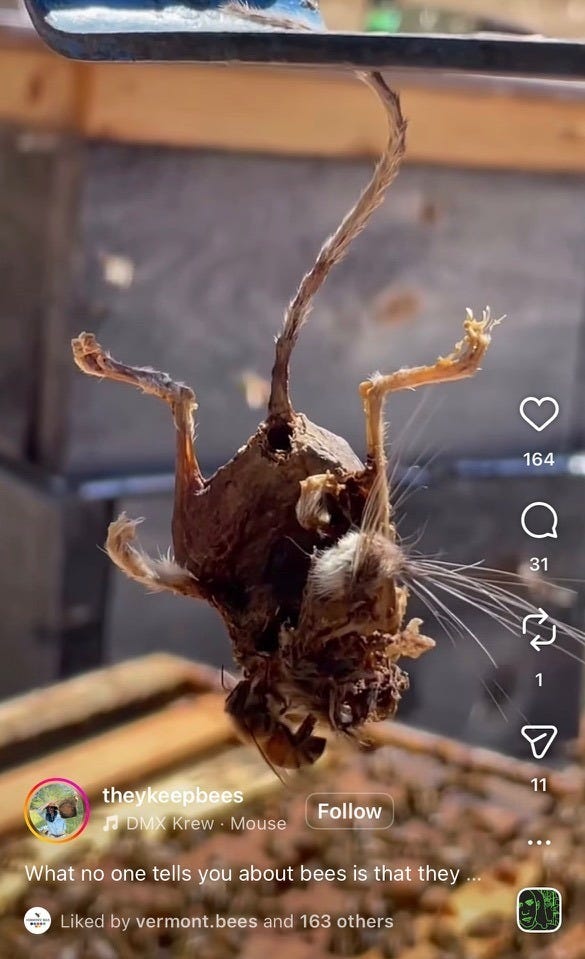
A particular segment catches my eye. The reporter is asking Curtis about how to keep the bees resilient and he responds with a story. At the end of last winter, he went into the shed to start getting ready for spring, and noticed a weird shape on one of the boxes. A mouse had snuck in during winter to use the bees for heat, but when they woke up for spring, the bees noticed an intruder and stung the mouse to death. Because he was too big to move, they covered him in propolis (basically “bee glue,” which forms the architecture of a hive) to prevent the spread of infection. The bees turned the mouse into a mummy. Curtis explained that, despite the common perception, the bees aren’t actually the one with the problem. “You find that, and you’re like, Wow, nature is heavy metal, man.”
I need to see this photo, I tell Max.
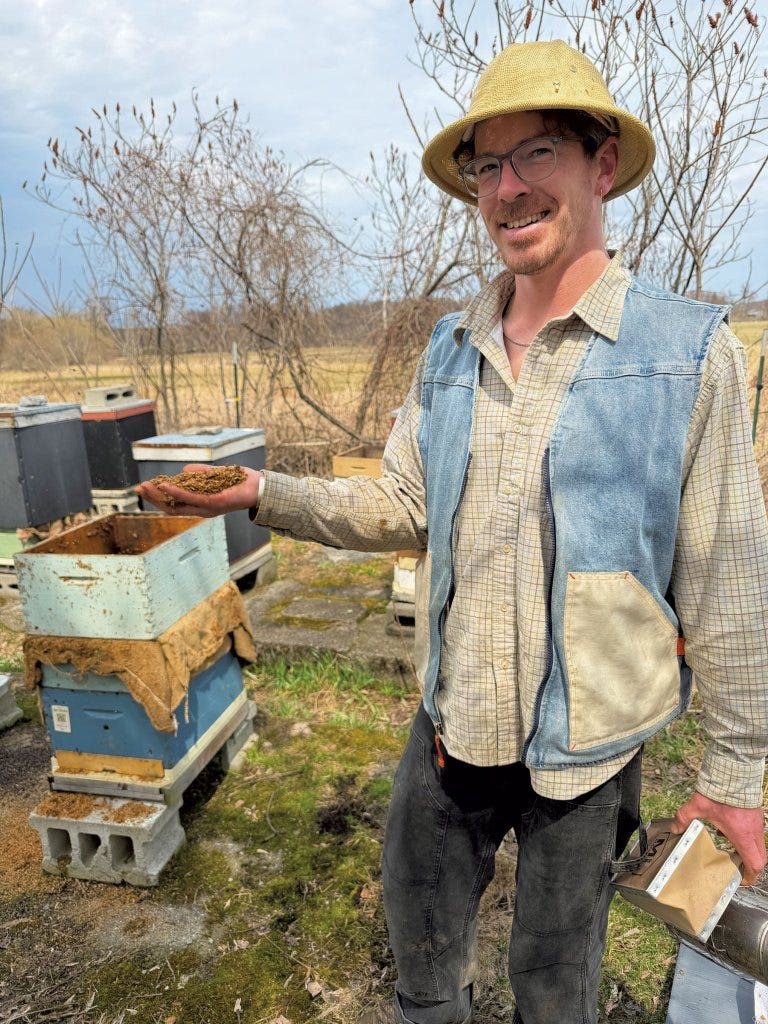
Most people don’t know this, but for the last few years my side hustle (or main hustle, depending on your perspective) has been building technology for commercial beekeepers. When I decide to share this at parties in New York, people usually squint their eyes, as if to say, ‘what?’ Then I ask them if they want the spiel and the answer is usually yes. I have learned that honeybees have a lot of goodwill in the culture.
The Spiel
For most of the 20th century, commercial beekeeping in America revolved around honey. But in the nineties, two events changed the ways that commercial beekeepers operated.
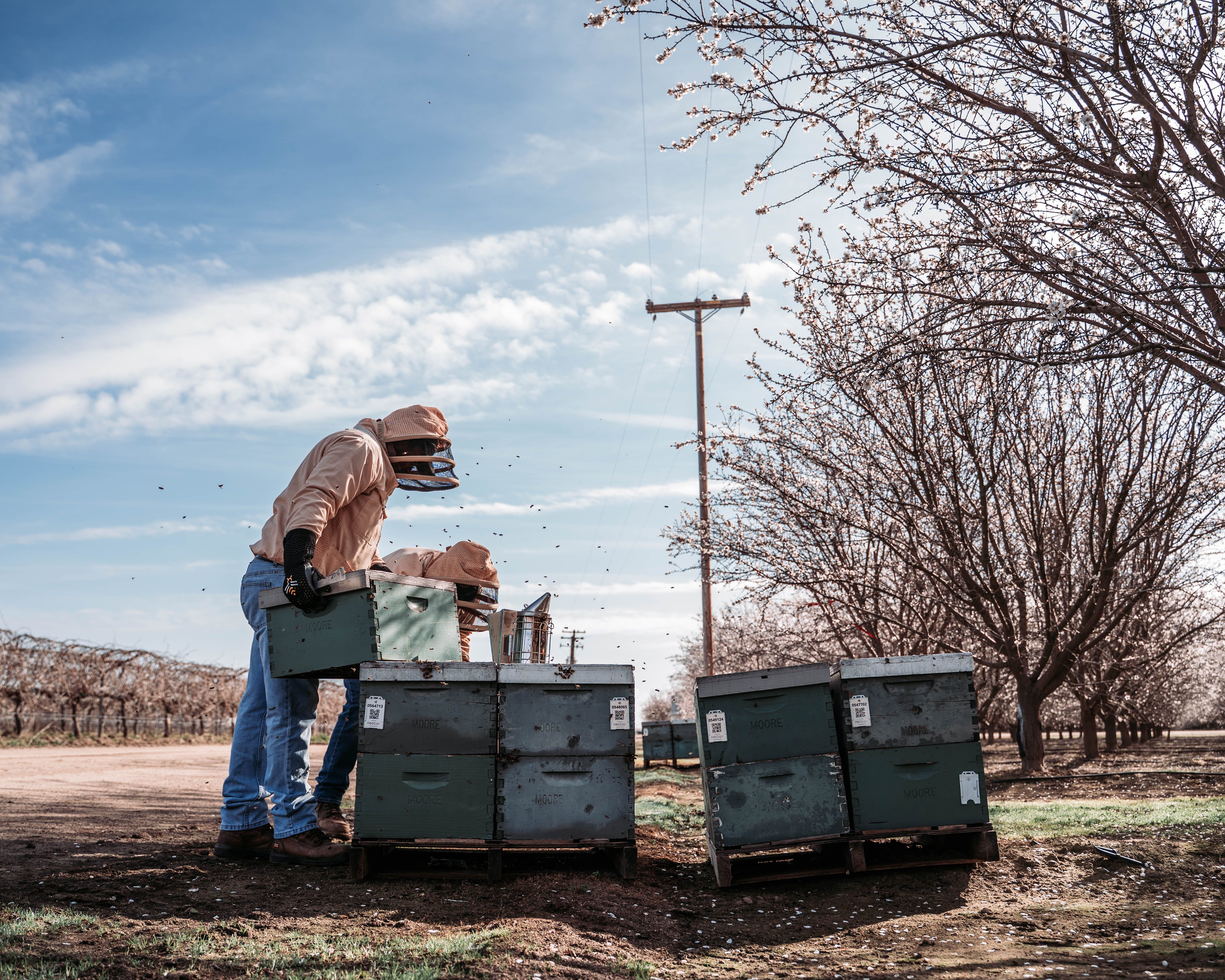
The first was a massive spike in demand for almonds. Yes, like the nut that became the staple of so-called “healthy food,” the main cow-milk alternative. 80% of the world’s almond supply is grown in California. But the Central Valley—being arid and covered in pesticides—is not a hospitable region for wild pollinators like bumblebees, hummingbirds, and monarch butterflies. So almond growers began to rent honeybees to grow their crops. 20% of the cost of an almond is from rented honeybees; about the same as the cost of irrigation. So to keep up with demand, beekeepers changed their business model. They began migrating their bees across the country every February for almond season. Nearly 2 million honeybee hives are shipped into California every year.
The second event was one of the consequences of shipping bees into a region sprayed with pesticides: they began to die. This started in the nineties with what became called “colony collapse disorder,” or CCD. It has since become much worse. Last year an industry report estimated that commercial beekeepers had an average mortality rate of 60% over winter. Hence the many marketing campaigns explaining that the bees are dying.1
Running a modern beekeeping operation, then, is less like traditional farming and more like managing a continent-spanning logistics network of living assets. Bees are sent to California in February for almonds, moved North in Spring for berry and citrus pollination, then to other regions in summer for honey production—before returning home in the Fall for winter.
At any given moment, a beekeeper might have thousands of hives scattered across multiple states, crops, and contracts. Each location exposes bees to different conditions—from climate and forage to pesticides—and each colony responds differently, shaping everything from honey yields to survival rates.
Yet despite the complexity, most beekeepers have relied until recently on paper notes, memory, or spreadsheets to track what happens in the field. For obvious reasons, these tools are no longer sufficient. When thousands of factors interact across millions of bees, even the best intuition can’t reveal why certain behaviors or genetics succeed—or fail. Only by tracing cause and effect can beekeepers manage their operations effectively.
**
When we arrive at the lake, about twenty beekeepers are hanging around, smoking joints and drinking mead. A curly haired thirty something in a flannel explains its his homemade brew. Mead is honey wine, he says, one of civilizations’ oldest drinks. You put yeast in a bucket with water and honey and the sugars ferment until they become wine. I take a sip and it’s tart and purple-colored like elderflower. I like it more than cider. I think of the Norse god Odin, who drank mead out of a ram’s horn to gain supreme wisdom; the Greeks who used mead in their prayers to Aphrodite—supposedly, to screw all night and seek prophetic visions.
Max is looking around for a girl I’ll call Sarah. A few months earlier they met at a beekeeping conference and hit it off but she had a boyfriend. He tells me she’s moving to New York to teach beekeeping to low-income kids in Red Hook. “Like she’s so fucking cool,” he says. He’s a little nervous to see her which makes me eager for her to arrive. The mead begins to hit as I pull out a cigarette while talking to one of Curtis’ employees.
I look him up and down and realize we’re wearing the same outfit. I’m wearing blue Wrangler cargos and a long denim jacket. He’s wearing green Wrangler cargos and a flannel with heavy pockets. I look around and everyone is wearing cargos and workwear, Carhartt’s and leather boots.
I once tweeted that, in socialist Brooklyn, people wear baggy pants as an ironic form of worker solidarity. Now I’m just embarrassed.
**
I share my embarrassment with Juliana, Curtis’ girlfriend, a singer from Brooklyn who’s been commuting to Vermont on the weekends.
She’s wearing a pink velour tracksuit and wide-brim yellow sunglasses. She needs to be in New York for her career, she says, but she needs to be in Vermont for her sanity.
She walks me through the house to put my cabbage dish into the oven. The house is frozen in time from the seventies: hardwood cedar flooring and posters of fish and fowl, plaid sofas of itchy flannel with a cast-iron fireplace in the middle.
Curtis walks in and says that his grandfather built the place to keep the family together. Upstairs there’s about twenty bunk beds where all the grandkids would sleep.
Thinking like ambitious technologists, Nectar’s founding team first attempted to solve beekeepers’ problems with a fancy device: a sensor that would go in each hive, collecting heat, sound, and humidity data to give beekeepers an early warning sign of trouble ahead.
But the sensors were too expensive, they never worked properly, and it was a solution that beekeepers never wanted. So it failed. Nectar went back to the drawing board, and started asking beekeepers what they wanted. The answer was a tracking system. So they slapped a QR code onto each hive, made an app that allows workers to enter reports, and built a dashboard where this information comes together, with other tools for things like insurance, mapping, and project management. Beekeepers wanted to know which contracts were killing bees, and Nectar made a simple system to show them.
I think of Nectar as a good argument for “dumb tech,” and I mean it in the most flattering possible way.
**
Sarah arrives and Max is playing it cool. She’s brought an insufficiently massaged kale salad so we are teasing her about the kale’s firmness. There’s a firepit at the center of the party and Curtis is putting on logs every few minutes. One of his workers is smoking weed out of a glass pipe. Juliana is cracking jokes and passing out home made cannolis.
One of the cool things about Nectar is that, as it’s grown, the company has developed the largest ever database of field conditions in beekeeping. The data is all anonymized and encrypted but it’s usable at an industry level. This is important because one in three bites of food produced in North America is grown with rented honeybees. So bee health can act as a proxy for the entire agricultural system. If you think of bees as living biosensors, and beekeepers as environmental stewards, then Nectar has a kind of pulse on food production conditions across millions of acres. And eventually, Nectar wants to use that data to build a numerical case for biodiversity.
Another cool thing about Nectar is that, recently, the technology has stopped being “dumb.” One of the advantages of having enormous volumes of data is that, if you have a new hypothesis, you can test it really quickly. Recently that happened when Nectar’s CTO began to wonder if the sound that hives produce could tell you what was going on inside. He started collecting thousands of hive recordings and matching the audio patterns to field conditions. Eventually he learned that with 15 second audio recordings you could predict—with startling accuracy—the strength of a hive, whether it’s infected with mites, and whether it has a queen. For context, using traditional methods it would take a beekeeper about 15-20 minutes to get this information. So it’s a 20X improvement on the next-best technique; a big deal for beekeepers who are chronically short on time. It’s also an interesting story about the path dependencies of tech development: how taking the dumb route can lead to a smarter solution.
I’m talking about this new audio tool, Meli, with a beekeeper named Bianca. Everyone at the party says she has the best honey; it’s next level, they rave. She runs about 500 hives with her husband. He’s handsome and sturdy with a greying beard. She says that, by default, they don’t wear suits or gloves when they work in the field. The bees can sense fear and it’s important to be present when you’re opening a hive. You have to remember to breathe, she says, and removing protection slows you down. Without a suit you become part of the organism, she says. You surrender to the work.
I realize, a second later, that I’ve been holding my breath.
Her comments have me thinking about the artificiality of New York City. When people used to visit from out of town, I would take them to the Hudson, point at the water and wax poetic about how it looks like a natural landscape but actually it’s a mechanical organism—copper cables and metro tunnels, suspended by concrete and reinforced steel. The river facade is no more ‘natural’ than the glass buildings being reflected, I would say. Now the same process is happening with honey bees. They’re not the mechanical insect demons that people ask about when you mention the future of beekeeping. But they’re definitely cyborgs of some kind. I take another swig of mead as Bianca passes me a cannoli. I try to imagine beekeeping without a suit.
**
The subtext of my visit to Vermont is helping Max through a personal crisis. On a hut trip this winter he injured his ankle, so for the last few months he’s been holed up, the balance of his life thrown. When he could finish work and go climb a mountain it was possible to devote himself to work. But without that exertion, he’s been stir crazy; doubting whether Nectar can change farming in the way he wants. A few weeks ago, he tells me, him and Curtis were talking about Nectar, and Max was excited about the new possibilities. “We’re close, right?” he said. “I really believe we’re close.” Curtis stopped him and said, “You realize that we’re losing?” The regime of pesticides and monocropping is only becoming more entrenched, he said. This is a generational battle and we’re only in the first few innings.
For Max, it was a hard truth. He’s been working on Nectar for over eight years, starting back when they were selling sensors that didn’t work. If it had taken this long and they’d only gotten this far, how long until they actually solve the central issues? Moreover: Could they win? Like the rest of farming, beekeeping is stuck in a downward spiral of bandaid solutions: pesticides kill the bees, antibiotics are needed to protect them, the chemicals cause more damage and biological resistance. This leads to more dead bees. To break out of the spiral you need to understand it numerically, and that’s what Nectar is trying to do. But that means battling a pharmaceutical industry with every incentive to prevent change.
This idea of a ‘generation battle’ has me thinking about Star Wars and accelerationism: how fighting an enemy that’s technologically sophisticated creates an arms race of technological sophistication. The AI super-computer cracks the encryption codes so you need AI super-encryption. China creates an internet firewall so you need satellites to penetrate the shield. The bees are dying from pesticides so you need antibiotics. But it’s a fake solution. Only systems change can break the cycle. It’s a cycle Nectar is trying to break by converting hundreds of thousands of hives into a singular dataset-organism. Their mission: give bees a voice. But it’s still kind of like bringing a lightsaber to a fight with the deathstar. Everyone here seems to know the stakes.
**
The best I could offer Max as consolation is a practice I call ‘spiritual hygiene.’ We spoke about it that morning by a river near his house.
Unlike work-life balance that’s predicated on some magical centerpoint between effort and play, spiritual hygiene is about cultivating perspective on the relationship between self and world. Reminders that you are dust. That you are not the center of the universe. That you are often powerless in the face of larger forces. That you simply don’t know.
Religious practices for millennia have focused on reminding people of these truths through ritual: daily prayers thanking god for existence, blessings at the start of meals. In the secular world these acts are treated as window-dressing. But they are vessels of epistemic truth. Faith is not an opiate or a bandaid. It’s a way to mediate between the particular and infinity; a daily practice.
**
The party is winding down and the lake is covered in moonlight.
I notice that one girl’s earrings are shaped like honeycombs. Another guy shows me his honey bee tattoo. Curtis is talking about bee venom therapy. Supposedly, bee stings can inoculate you from all kinds of diseases.
At Nectar, I’ve always avoided honeybee metaphors because I felt it was a little too on the nose. But looking around, I wonder if that’s true.
Max and Sarah are talking by the campfire. Juliana is dancing.
The Jedis are drunk and they’re drinking mead.
A misleading campaign since there are more honeybees alive today than ever, and, in commercial beekeeping, when a hive dies (i.e. the queen is killed, or leaves) it’s simply fixed with a new queen and converted into a new hive. This is to say that the bees are dying at ever-faster rates, but the main risk of these deaths is to the sustainability of beekeepers’ businesses, not the existence of the species.
Hear me out, Sam: bees….but on the blockchain.